
How to Start an Export Business in India: Registration Guide 2026
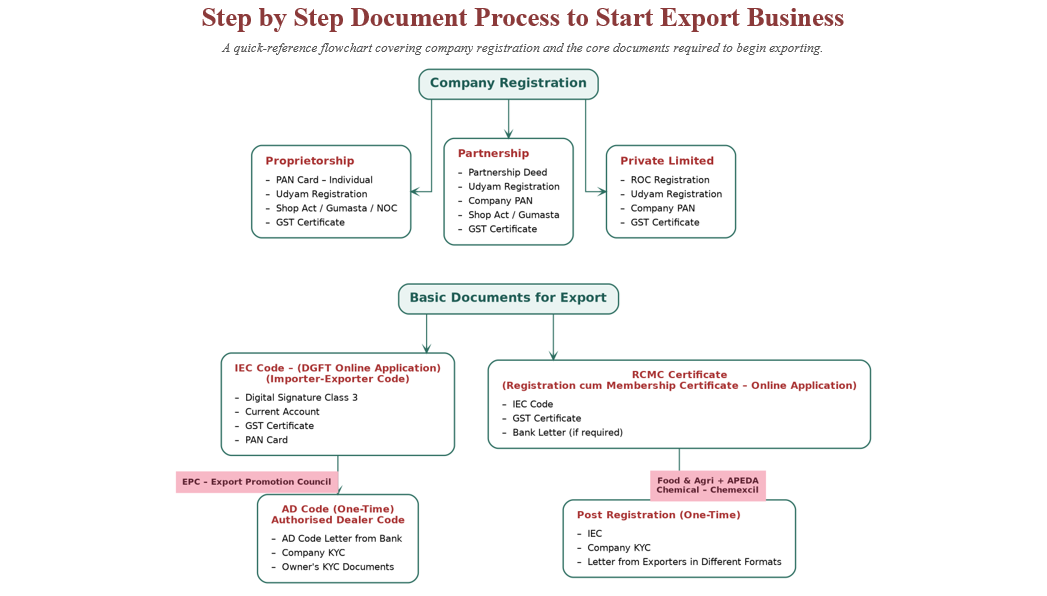
Starting an export business in India requires careful planning, appropriate business registration, and the preparation of essential documents. Entrepreneurs who want to enter the export sector must first select a suitable business structure based on their investment capacity, business objectives, and operational requirements. Several options are available, including a proprietorship firm, a partnership firm, a One Person Company (OPC), and a Private Limited Company. Each structure offers a different approach to establishing and operating a business.
For new exporters, a proprietorship firm or a One Person Company can be an attractive starting point because these structures may require relatively low initial investment, depending on the registration requirements and professional services involved. Entrepreneurs who plan to establish a business with a partner may consider a partnership firm, while manufacturers and businesses planning to expand their operations may choose a Private Limited Company.
After registering the business, entrepreneurs must obtain the necessary documents to conduct export activities legally. These documents include the Importer-Exporter Code (IEC) and, where applicable, a Registration-cum-Membership Certificate (RCMC). The Directorate General of Foreign Trade (DGFT) issues the IEC, while the relevant Export Promotion Council (EPC) or designated organisation handles the applicable registration and membership requirements.
Understanding these procedures helps entrepreneurs organise their businesses, prepare the required documentation, and establish a foundation for international trade.
1. Choosing the Right Business Structure
The first step in establishing an export business is selecting a suitable legal structure. Entrepreneurs should consider whether they intend to operate independently, collaborate with another person, or establish a company with a more formal corporate structure. The choice affects the registration process, documentation requirements, and administrative responsibilities.
A proprietorship firm is generally suitable for an individual who wants to start a business independently. A partnership firm provides an option for two or more individuals who want to operate a business together. A Private Limited Company offers a formal corporate structure that may suit manufacturers and entrepreneurs who plan to expand their operations.
A One Person Company is another option for an individual who wants to establish a company with a single member, subject to the applicable legal requirements. However, its registration and compliance requirements differ from those of a proprietorship firm. Entrepreneurs should therefore evaluate the advantages, costs, and responsibilities associated with each structure before making a decision.
The following sections explain the principal registration procedures described in this guide.
2. Registering a Proprietorship Firm
A proprietorship firm is one of the simplest business structures for an individual who wants to begin an export business with limited initial investment. Under this arrangement, one person owns and manages the business. The proprietor makes business decisions, handles daily operations, and assumes responsibility for the firm's activities.
The first important document is the proprietor's Permanent Account Number (PAN) card. Unlike a partnership firm or a Private Limited Company, a proprietorship generally does not require a separate PAN in the business's name. Instead, the proprietor uses their individual PAN for the business's tax-related requirements.
For example, suppose an individual named Vijay decides to establish a proprietorship firm. Vijay can use his personal PAN card as the PAN associated with his proprietorship. He must then arrange the other documents required to establish and operate the business.
The next step involves obtaining appropriate business registration or establishment documentation. Depending on the location and applicable requirements, the proprietor may need a Shop and Establishment registration, commonly referred to as a Shop Act licence or Gumasta licence. In certain circumstances, an appropriate No Objection Certificate (NOC) may also form part of the documentation.
The requirements can vary according to the location in which the business operates. In many Tier-2 and Tier-3 cities, obtaining the relevant Shop Act documentation may be relatively straightforward. However, entrepreneurs who establish their businesses within a Gram Panchayat jurisdiction may need to follow a different procedure.
In such cases, the entrepreneur may approach the Gram Panchayat and submit a request explaining the intention to establish a business under a specified name. The Gram Panchayat may issue an NOC or other relevant document, subject to its applicable rules and procedures. The entrepreneur should confirm the exact requirements with the local authority before proceeding.
After arranging the necessary business documentation, the proprietor should open a current account with a bank in accordance with the bank's requirements. A current account allows the business to manage its commercial transactions and receive or make payments associated with its operations.
The entrepreneur can then apply for Goods and Services Tax (GST) registration when required or appropriate for the business. The GST certificate serves as evidence of the business's GST registration. The applicant must submit the necessary information and supporting documents through the applicable registration process.
This approach allows an individual to establish a business without creating a separate incorporated company. However, the proprietor should confirm the current registration requirements, GST applicability, and documentation rules before starting operations.
3. Establishing a Partnership Firm
A partnership firm is a suitable option for individuals who want to establish and manage a business together. For example, two friends who wish to enter the export market may decide to combine their capital, knowledge, and business resources through a partnership.
The first important step is preparing a partnership deed. This document records the terms agreed upon by the partners and establishes the framework for their business relationship. It can specify the partners' contributions, responsibilities, profit-sharing arrangements, decision-making procedures, and other relevant conditions.
Entrepreneurs can seek assistance from a lawyer or another qualified professional to prepare the partnership deed. A clearly drafted deed helps establish the partners' respective rights and responsibilities and provides a formal basis for operating the business.
After preparing the deed, the partners should complete the applicable business registration procedures. The process may include Udyam registration if the business qualifies for it and the partners wish to register as a micro, small, or medium enterprise under the relevant framework.
The partnership firm also requires a PAN card in its own name. This requirement differs from the proprietorship structure. Because the partnership firm operates as a separate taxable entity, it generally needs its own PAN rather than relying exclusively on the personal PAN of one partner.
To obtain the firm's PAN, the applicants must submit the required application and supporting documentation, including the partnership deed or other documents specified under the applicable process.
The partners must also obtain the relevant business establishment documentation, such as a Shop Act licence where applicable. They should then arrange GST registration if required under the applicable rules.
Once the partnership has completed the necessary formalities, the partners can open a current account in the firm's name. The bank will determine which documents it requires to verify the partnership and authorise the account.
A partnership can be particularly useful when two or more individuals have sufficient capital and want to share the responsibilities of running an export business. Nevertheless, the partners should establish clear financial arrangements and understand their legal responsibilities before commencing operations.
4. Registering a Private Limited Company
A Private Limited Company provides a formal corporate structure for entrepreneurs who want to establish a business with defined ownership and management arrangements. Manufacturers, small production units, and businesses planning to expand their operations may consider this structure because it provides a framework for organising the company's activities.
The registration process involves the Registrar of Companies (ROC), which operates under the Ministry of Corporate Affairs. The promoters must follow the applicable incorporation procedure and submit the prescribed documents and information.
Once the authorities approve the application, the company receives a Certificate of Incorporation. This certificate confirms that the company has been legally incorporated under the applicable company law.
After incorporation, the company must obtain its PAN and complete any other applicable tax and business registration requirements. Unlike a proprietorship, a Private Limited Company requires a separate PAN in the company's name because it is a distinct legal entity.
The company should also evaluate whether it qualifies for Udyam registration and complete the process if appropriate. It must obtain GST registration when required and arrange the other licences or registrations applicable to its activities and location.
Opening a current account in the company's name is another important step. The company can use this account to manage business income, supplier payments, export proceeds, and other commercial transactions.
Entrepreneurs must also meet the applicable requirements concerning directors, shareholders, and corporate compliance. A Private Limited Company generally requires at least two directors under Indian company law, rather than the minimum of three or four directors suggested in the original explanation. The company must also satisfy the applicable minimum membership requirements and other statutory conditions.
Although incorporation may involve greater administrative responsibilities than establishing a proprietorship, a Private Limited Company can provide a structured foundation for manufacturing, commercial operations, and business expansion. Entrepreneurs should assess the associated costs and ongoing compliance obligations before choosing this structure.
5. Understanding the Essential Documents for Exporting
After establishing the business, the entrepreneur must obtain the documents required for international trade. These documents help identify the business, establish its eligibility to undertake relevant activities, and satisfy applicable regulatory requirements.
Two important documents discussed in this guide are the Importer-Exporter Code (IEC) and the Registration-cum-Membership Certificate (RCMC). Their requirements depend on the nature of the business and the products involved.
The IEC identifies an importer or exporter for the purposes of India's foreign trade framework. The RCMC, where required, establishes registration or membership with the relevant export promotion organisation.
Entrepreneurs should understand the purpose of each document and identify the registrations applicable to their particular products before beginning export transactions.
6. Obtaining the Importer-Exporter Code (IEC)
The Importer-Exporter Code, commonly known as the IEC, is a key requirement for businesses involved in importing or exporting goods from India. The Directorate General of Foreign Trade (DGFT) issues the code under the applicable foreign trade framework.
Businesses should apply through the official DGFT website and follow the prescribed online application procedure. The applicant must provide the required business information and supporting documents for verification.
The IEC serves as an identification code for import and export activities. It helps the relevant authorities identify the business involved in international trade and associate the applicable transactions with the registered importer or exporter.
The original transcript states that the government application fee is ₹500 and that applicants can typically receive their IEC within 24 hours. However, applicants should verify the current fee, processing time, and applicable requirements directly through the official DGFT portal because these details may change. Processing also depends on the completeness of the application and successful verification.
Documents required for an IEC application
Applicants should prepare the relevant documents before beginning the application process. The exact requirements depend on the applicant's business structure and the current DGFT procedure.
The principal documents and information described in the transcript include the following:
First, the applicant may need a valid digital signature. The transcript refers specifically to a Class 3 Digital Signature Certificate. Applicants should confirm the current digital authentication requirements on the official DGFT portal before purchasing or using a digital signature.
Second, the applicant needs the relevant current account details. A business that has established a current account should keep the account information and any supporting banking documents required by the application process readily available.
Third, the applicant should prepare the GST registration certificate, where applicable or required for the application. The certificate provides details associated with the business's GST registration.
Fourth, the applicant must provide the appropriate PAN details. For a proprietorship, the proprietor's individual PAN generally serves as the business's PAN. For a partnership firm or Private Limited Company, the applicant should use the PAN issued in the firm's or company's name.
The applicant must submit the required information through the official application system. After the authorities verify the application and supporting details, they issue the IEC in accordance with the applicable procedure.
Obtaining the IEC is an important milestone for a new exporter. However, entrepreneurs should not assume that the IEC alone satisfies every regulatory requirement. Depending on the goods and the nature of the transaction, they may need additional registrations, licences, certificates, or approvals.
7. Obtaining the Registration-cum-Membership Certificate (RCMC)
After obtaining the IEC, the exporter should determine whether the intended products require an RCMC or another form of registration with a relevant export promotion organisation.
The Registration-cum-Membership Certificate establishes the exporter's registration or membership with the appropriate organisation, depending on the product category and applicable rules. Different organisations focus on different sectors, allowing exporters to approach the body responsible for their particular goods.
India has established Export Promotion Councils and other designated organisations to support and represent various product sectors. Exporters should identify the organisation that covers their products and review its registration requirements before applying.
For example, an entrepreneur who intends to export eligible agricultural or food products may need to approach the Agricultural and Processed Food Products Export Development Authority (APEDA), depending on the product and the applicable regulatory framework.
Similarly, an exporter dealing in chemicals should identify the relevant export promotion organisation responsible for the particular chemical products. The exporter must then complete the applicable registration or membership procedure where the rules require it.
Selecting the correct organisation is important because different products may fall under different regulatory or sectoral arrangements. Entrepreneurs should therefore identify their products accurately and verify which organisation has jurisdiction over the relevant category.
The original transcript refers to 12 Export Promotion Councils. However, exporters should verify the current list of councils and designated organisations, along with their respective product coverage, before relying on a fixed number. The number and responsibilities of relevant organisations may differ according to the classification and regulatory framework being considered.
An exporter should also distinguish between an RCMC and other mandatory product-specific approvals. Membership with an export promotion organisation does not automatically replace every licence, certification, or authorisation that a particular product may require.
8. Organising the Registration Process Efficiently
Entrepreneurs can make the registration process easier by preparing the necessary documents in a logical sequence. They should first decide which business structure suits their objectives and then complete the relevant registration formalities.
A proprietor should arrange the personal PAN details and the applicable business establishment documents. Partners should prepare their partnership deed and obtain the partnership firm's PAN. Promoters of a Private Limited Company should complete incorporation and obtain the company's PAN.
After completing the relevant business formalities, the entrepreneur should arrange a current account and complete the applicable GST registration requirements. The business can then prepare its IEC application through the DGFT's official system.
The exporter should also identify the intended products and determine whether the relevant Export Promotion Council, APEDA, or another designated organisation requires registration or membership. Where additional product-specific permissions apply, the entrepreneur should address those requirements separately.
Keeping accurate records of the business registration certificate, PAN, GST certificate, bank details, IEC, and applicable export registrations can help the business manage its documentation more effectively. Entrepreneurs should also check official sources for current fees, processing times, eligibility conditions, and document requirements rather than relying exclusively on informal guidance.
Summary Table
| Business structure or document | Main purpose | Key requirements or considerations |
| Proprietorship firm | Allows an individual to operate a business independently | Individual PAN, applicable business establishment documents, bank account, and GST registration where required |
| One Person Company (OPC) | Provides a corporate structure for an eligible single-member business | Incorporation, company PAN, applicable tax registrations, and corporate compliance |
| Partnership firm | Allows two or more individuals to operate a business together | Partnership deed, firm's PAN, applicable establishment documents, bank account, and GST registration where required |
| Private Limited Company | Provides a formal corporate structure suitable for various commercial activities | ROC incorporation, Certificate of Incorporation, company PAN, applicable GST and other registrations, and statutory compliance |
| Importer-Exporter Code (IEC) | Identifies an eligible importer or exporter under India's foreign trade framework | Application through the DGFT system and submission of the prescribed information and documents |
| Registration-cum-Membership Certificate (RCMC) | Establishes registration or membership with the relevant export promotion organisation where required | Selection of the appropriate organisation according to the product category and applicable rules |
| APEDA or other sectoral registration | Addresses relevant sector-specific registration requirements | Applicability depends on the products being exported and the governing rules |
| Current account | Supports the business's commercial banking transactions | Account opening in the appropriate proprietor, firm, or company name, subject to bank requirements |
rutvik
rutvik is a Senior Journalist dedicated to bringing you the most accurate and up-to-date coverage. With a commitment to journalistic integrity and deep research, every piece is vetted for quality and truth.