How to start import and export in India in 2026, step by step gaudiness.
Import export business is a perfect balance between product, set up business, capital, gov licenses and arrange shipment with cold head management.
Because of central gov skims and subsidies for new startup maundering industry’s manufacturing of products are Increasing day by day. Like textile industry, machine part’s maundering industry, pharmaceutical medicines etc...
In international market there is high demand of medicines, international quality Machine parts, India spices, textile, handloom, sea food, and much more
As per the Ministry of Commerce and industry in FY 2025-2026 Total export was 863.1 billion USD, Merchandise exports wat highest export industry with 441.8 billion USD, current year 2026 numbers are first quarter total exports: 232.73 billion USD.
Gov back support with their import export schemes like EPCG, RoDTEP, and Interest Equalization make it easier to invest in technology, recover taxes, and manage finances effectively.
Step 1: Choose Right product For You.
Before you could choose your product or industry for next step consider some point like did you have any business background (does your family doing some kind of business), how much time & money you could able to spend here. What If it’s couldn’t work for you, what if you scam by Spiller or buyer, and after all of this you should have some financial support for your family and your future.
After all of this answer Select your product category and two or three countries. I would suggest you select product according to near availability of product (~200Km), if your product category is so far from your city it could you cost you more in starting days. If you select export so in first product should be finish goods like Furniture, Handicraft, Textile business, Leather product etc. don’t export row product or expiry product like frozen food, vegetable, sea & non-veg food etc... and if you could choose import don’t import scrap and all same goods item don’t export.
At first required your money spending power would be between 5L to 10L, I strongly suggest you go with less expensive finish product, which are cost you ~2000 INR in India with tax and export quality material, this is another category’s
- Pharmaceutical
- Chemical
- Automobile parts
- Machine parts
- Agriculture Equipment
- FMCG Products
- Petroleum, etc...
For Choosing Country’s based on Analyze of Indian Ministry Commerce and Industry (trade-analytics.commerce.gov.in) Website And according to every country import and Export data of your Products and category.
For details of every category and countries visit DGFT trade statistics, APEDA data, and FIEO reports to identify products with global demand and favorable Indian pricing.

Step 2: Choosing Business Entity.
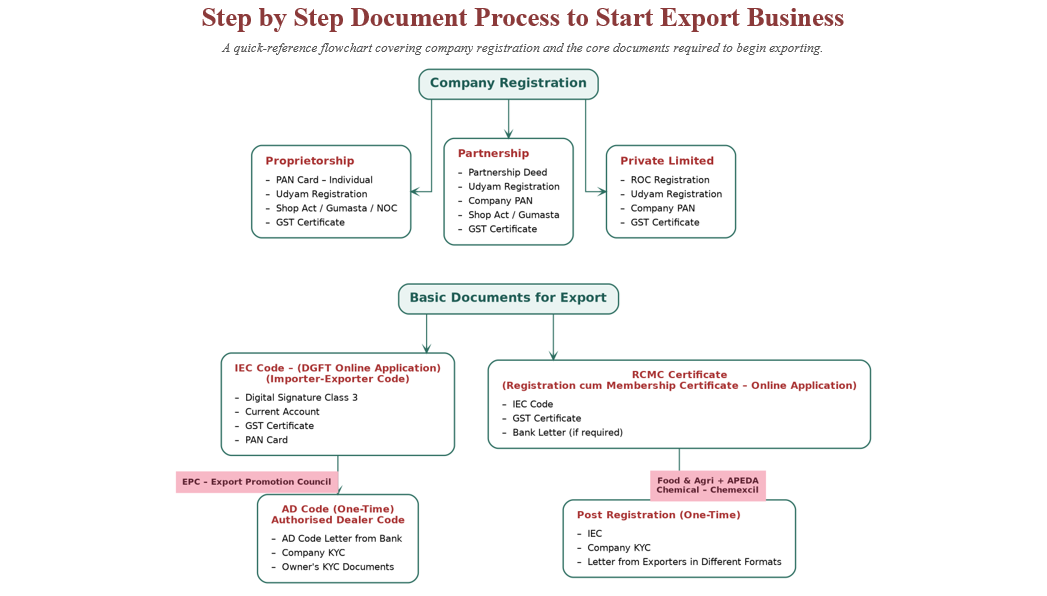
There is a three-business entity, which you would Choose according to your scale and investment of Import and export business.
If you are Starting your export and export journey individually in that Scenario, proprietorship would be the best option for you. Only one person could register their company under proprietorship
LLP required at list two shareholder in company these types of company’s we call as a partnership company’s, in general. I would suggest you if you’re thinking of starting company, check your Compliance with your partner.
PVT LTD you need at least 2 directors, 2 shareholders at company with registration of Unice company name and so much more documents it mainly for self-Manufacturers product’s company.
Step 3: Apply for IEC (Import Export Code) Ang GST registration.
IEC: is a most important document in import and export it’s a CODE provided by Indian gov for import and export, every code has a different Unice code, without this code your import or export consignments would not be moved, customs authorities would not clear your goods for import or export, regardless of what other licenses or registrations you hold.
You could apply from the Directorate General of Foreign Trade (DGFT) website (dgft.gov.in) applicants could file the IEC registration online through the DGFT portal, the official government fee for an IEC is ₹500 and the code is typically issued within 5 working days after document verification (in some case it’s tack only few hours after document verification).
GST: you must register if you are exporter, it’s mandatory, if your annual turnover goes above 20 lakh INR (or 10 lakh INR in certain special-category states) many service exporters choose to register even before reaching the limit so they can use the same benefits as registered businesses. (Export goods or services after paying IGST and claim a refund later) apply for GST registration through the official GST portal (gst.gov.in).
Step 4: Register AD Code and RCMC Certificate.
RCMC: Registration Cum Membership Certificate (RCMC) this certificate would be issue after you became a member of any EPC (Export Promotion Council). Without this certificate you couldn’t applying for gov benefits or skim’s, it would Mack costume clarence so easy and increase your creditability in export.
AD Code: Authorized Dealer (AD) Code links the business's bank account to the customs port of export. Your bank registers the AD Code with customs through the ICEGATE portal (icegate.gov.in) if your back account could not connect with AD code and you received payment from buyer and then you couldn’t stop IBRC and then you have to face some notices from RBI.
Step 5: Find Buyers or Suppliers.
You could Use platforms like IndiaMART, Alibaba, TradeIndia, and the FIEO Global Connect directory to find international buyers. Attend Export Promotion Council events, trade fairs, exhibitions, and government buyer-seller meets to build business connections and generate export opportunities.
What I would suggest, you have to visit that city of country from where you going to spend money time and energy for Future. This way you got Very clear idea of buyer or supplier and some question related to that like How capable they are? Does they are Able to Supply that product or they able to buy, what is final product which would you received.
Step 6: Position Your Products Internationally.
Build and present your product with international stander is the not skippable option for you, if your exporter so this is an indeed important, here some suggestion from my side
Exporter’s
- Present your product at internation B2B websites has many has possible.
- Also make Multilanguage website for your internation clients.
- Add official’s certificates and Marko’s and highlight them in home pages
- Use Premium quality material for packaging according to your category.
- High-quality product is a bar minimum in import and export.
- Show case your products at trade fairs and Gov led buyer and seller meets directly to the foreign buyers.
- Etc...
Importer’s
- Create your company image strong international so international seller could build their trust in your company.
- If you have then Show your national reputed awards and certificate’s.
- If you personally reworded with current gov then show on your company website and in marketing of your company.
These are some ideas for you so you could position your product internationally

Step 7: Shipping and Logistics
Carefully plan shipping and logistics to ensure timely delivery of goods and compliance with international quality standards, File the Shipping Bill on ICEGATE independently if confident with the required documentation, consider hiring an experienced Customs House Agent (CHA).
especially for first-time exporters, to handle the Shipping Bill and comprehensive export paperwork, as mistakes can lead to delays or shipment blocks, Select a dependable freight forwarder to oversee transportation, warehousing, and customs clearance at both the origin and destination points , Evaluate options between sea freight, air freight, or courier services based on product type, order value, and delivery schedule, Ensure shipments are safeguarded against potential damage, theft, or loss during transit.
rutvik
rutvik is a Senior Journalist dedicated to bringing you the most accurate and up-to-date coverage. With a commitment to journalistic integrity and deep research, every piece is vetted for quality and truth.